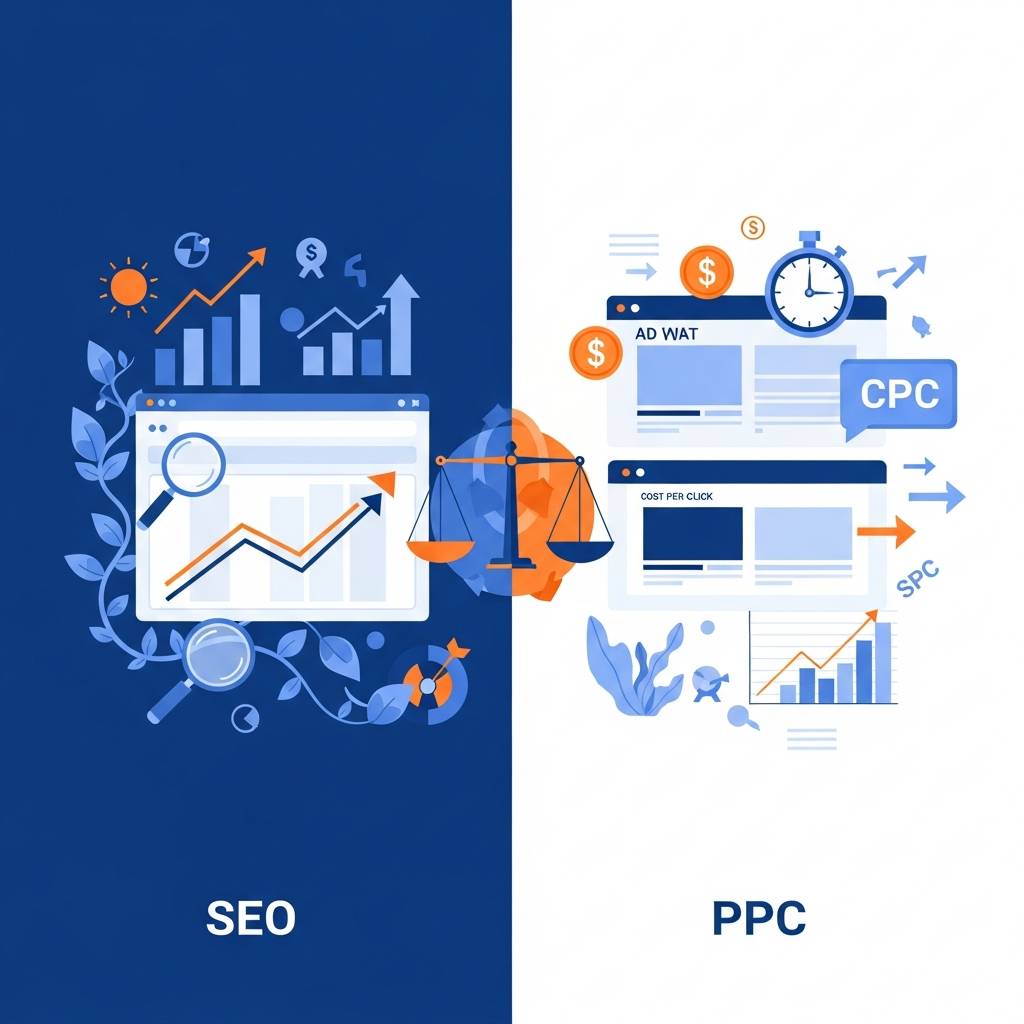
Are you constantly debating whether to allocate your digital marketing budget to Search Engine Optimization (SEO) or Pay-Per-Click (PPC) advertising? You’re not alone. In today’s competitive digital landscape, making the right choice between these two powerful strategies can be the difference between exceptional growth and wasted marketing dollars.
With search engines driving over 68% of website traffic and digital ad spending projected to reach $645 billion by 2024, understanding when and how to leverage both SEO and PPC has never been more critical for businesses of all sizes. This comprehensive guide will help you navigate the complex decision-making process with data-backed insights and expert recommendations tailored to your specific business needs.
Whether you’re a startup looking to establish your digital footprint or an enterprise aiming to maximize your return on investment, this article provides the strategic framework you need to optimize your marketing budget allocation and achieve sustainable, measurable results in an increasingly competitive digital marketplace.
1. The Ultimate SEO vs. PPC Showdown: Where to Allocate Your Marketing Budget in 2023
Digital marketing presents businesses with a crucial decision: invest in Search Engine Optimization (SEO) or Pay-Per-Click (PPC) advertising? This fundamental choice influences not only your marketing budget allocation but ultimately determines your digital visibility and conversion rates. While SEO builds long-term organic traffic foundations, PPC delivers immediate visibility with measurable costs per acquisition. According to industry research, companies that strategically balance both approaches see 25% higher conversion rates than those focusing exclusively on either channel.
For established brands with stable revenue streams, allocating 60-70% to SEO while using PPC for competitive keywords and promotional campaigns often yields optimal results. Conversely, startups and businesses entering new markets typically benefit from heavier PPC investment (50-60% of budget) to gain immediate market presence while gradually building SEO capabilities. Companies like HubSpot and Moz have demonstrated this hybrid approach, leveraging PPC for immediate lead generation while simultaneously investing in comprehensive SEO strategies that deliver compounding returns over time.
The decision ultimately depends on your industry competitiveness, business maturity, and revenue goals. E-commerce businesses often benefit from equal investment in both channels, with SEO driving product category traffic and PPC capturing high-intent purchase queries. B2B companies with longer sales cycles typically see higher ROI from content-driven SEO strategies supplemented by targeted PPC campaigns for bottom-funnel prospects. Whatever your industry, regular performance analysis comparing customer acquisition costs and lifetime value across both channels should guide your ongoing budget allocations.
2. 10 Data-Driven Insights to Decide Between SEO and PPC for Your Business Growth
Making the right choice between SEO and PPC can dramatically impact your digital marketing ROI. Let’s dive into ten evidence-based insights that will help you determine the optimal strategy for your specific business needs:
1. Conversion Rate Comparison: Data from Wolfgang Digital reveals that organic search traffic converts at 2.8%, while paid search conversions average 3.3%. For businesses needing immediate conversions, PPC often delivers faster results.
2. Budget Considerations: According to WebFX, small businesses spend an average of $9,000-$10,000 monthly on PPC campaigns, while SEO investments typically range from $1,500-$5,000 monthly but require 4-6 months to show significant results.
3. Customer Acquisition Cost (CAC): Research by First Page Sage indicates that the average B2B company’s CAC through SEO is $205, while PPC averages $535. For B2C companies, SEO CAC averages $39 versus $57 for PPC.
4. Purchase Intent Signals: Studies show that 80% of search queries are informational, with only 20% transactional. SEO excels at capturing informational queries, while PPC performs better for high-intent transactional searches.
5. Industry-Specific Performance: Financial services and legal sectors see average PPC costs of $3.77 and $6.75 per click respectively, making SEO potentially more cost-effective for these industries in the long run.
6. Market Position Analysis: Startups and new businesses often benefit from PPC to gain immediate visibility, while established brands can leverage their domain authority for stronger organic rankings.
7. Buyer Journey Mapping: SEO typically dominates early awareness stages, while PPC excels during the consideration and decision phases. Analysis of your sales funnel can indicate which channel deserves more investment.
8. Competitive Landscape Assessment: In highly competitive markets where the top 3 organic positions have >60% click-through rates, PPC may be necessary to gain visibility above entrenched competitors.
9. Lifetime Value Correlation: Companies with higher customer lifetime values can justify higher PPC costs, while businesses with lower margins often find better long-term ROI with SEO.
10. Traffic Quality Metrics: Google Analytics data consistently shows that organic traffic has a 20-30% lower bounce rate than PPC traffic, indicating potentially higher engagement quality from SEO efforts.
The optimal approach typically involves strategic allocation across both channels based on your specific business goals, competitive landscape, and customer journey. Leading brands like HubSpot allocate resources to SEO for long-term authority building while simultaneously running targeted PPC campaigns for high-intent keywords and new product launches. This balanced investment approach allows businesses to capitalize on immediate conversion opportunities while building sustainable organic traffic sources.
3. Why Successful Companies Use Both SEO and PPC: A Strategic Integration Guide
The most successful digital marketing strategies don’t rely exclusively on either SEO or PPC but strategically integrate both channels to maximize visibility and results. Companies that dominate their industries understand that these approaches aren’t competing tactics but complementary forces that, when properly aligned, create powerful marketing synergy.
Market leaders like Amazon, Home Depot, and Salesforce consistently maintain strong organic rankings while simultaneously investing in paid search campaigns. This dual approach allows them to occupy more real estate on search engine results pages (SERPs), effectively blocking competitors and creating multiple touchpoints with potential customers.
The strategic integration of SEO and PPC offers several distinct advantages. First, it provides comprehensive data insights that neither channel can deliver independently. PPC campaigns generate immediate keyword performance data that can inform SEO strategies, while SEO content performance can guide PPC ad copy optimization. This data exchange creates a continuous improvement loop that elevates both channels.
Additionally, using both approaches offers protection against algorithm updates and market fluctuations. When Google implements major changes, companies relying solely on organic traffic may experience significant disruptions, while those with diversified traffic sources maintain stability. Similarly, during competitive bidding wars that drive up PPC costs, strong organic rankings provide consistent traffic without increased expense.
For new product launches or time-sensitive promotions, the dual approach proves particularly effective. While building organic rankings takes time, PPC delivers immediate visibility. As organic rankings improve, companies can adjust their paid strategy—reducing spend on keywords where they rank organically while focusing PPC budgets on terms where organic visibility remains challenging.
The integration also addresses different stages of the customer journey. Research shows that users often conduct multiple searches before converting, alternating between informational and transactional queries. A combined SEO-PPC strategy ensures visibility throughout this process, with content-rich SEO assets educating prospects while targeted PPC ads capture high-intent conversion opportunities.
Implementing this integrated approach requires cross-team collaboration and unified measurement frameworks. Marketing departments that break down silos between SEO and PPC teams see the most significant returns, as shared learnings accelerate optimization across both channels.
4. SEO vs. PPC ROI Analysis: Which Delivers Better Long-Term Value for Your Industry?
When evaluating digital marketing strategies, the SEO versus PPC ROI debate remains one of the most critical considerations for businesses across industries. While both channels can deliver substantial returns, their value propositions differ significantly depending on your business goals, industry, and timeline expectations.
SEO typically delivers superior long-term ROI for most industries. Data from numerous studies shows that organic traffic continues to generate leads and conversions long after the initial optimization investment. For example, a well-optimized page ranking in the top three positions can continue driving traffic for years with minimal maintenance costs. In sectors like healthcare, education, and financial services, where trust factors heavily in decision-making, organic rankings often outperform paid placements in conversion rates by 20-30%.
However, PPC offers advantages that cannot be overlooked in your ROI calculations. The immediate visibility of paid campaigns provides measurable results within days rather than months. Industries with high-value transactions like legal services, where client acquisition values can exceed $5,000, often see exceptional PPC ROI despite higher cost-per-click rates. Similarly, e-commerce businesses during peak shopping seasons can achieve ROIs exceeding 400% through targeted PPC campaigns.
Industry-specific considerations significantly impact which channel delivers optimal value. Manufacturing and B2B sectors typically see stronger long-term performance from SEO investments due to longer sales cycles and research-heavy purchasing processes. Conversely, travel, hospitality, and retail often benefit from a balanced approach where PPC captures seasonal demand spikes while SEO builds sustainable traffic patterns.
The most comprehensive ROI analysis should account for customer lifetime value (CLV). Companies using attribution models that track CLV often discover that SEO-acquired customers demonstrate higher retention rates and lower acquisition costs over time, while PPC excels at targeting high-intent prospects ready to convert immediately.
Your competitive landscape also influences ROI potential. In highly competitive SERPs where ranking organically requires substantial resources, PPC may provide more cost-effective entry points. Alternatively, industries with prohibitively expensive keywords might find SEO a more sustainable investment despite the longer timeline to results.
Ultimately, the highest ROI comes not from choosing between SEO and PPC but from strategic integration. Companies implementing coordinated search strategies report 25% higher conversion rates than those treating channels in isolation. By using PPC data to inform SEO keyword targeting and leveraging SEO content within PPC landing pages, businesses can maximize the efficiency of their overall search marketing investment.
5. From Startup to Enterprise: How to Scale Your Digital Presence with Strategic SEO and PPC Investments
Scaling your digital marketing efforts requires a strategic approach that evolves as your business grows. For startups with limited budgets, focusing on targeted PPC campaigns can generate immediate visibility while gradually building SEO foundations. Companies like Dropbox and Airbnb initially leveraged PPC to gain market traction before developing comprehensive SEO strategies.
As mid-sized businesses emerge, the balance shifts toward a more integrated approach. At this stage, allocating 60% of resources to SEO development and 40% to refined PPC campaigns often yields optimal results. Take Slack’s journey—they maintained PPC campaigns for competitive keywords while simultaneously building authoritative content that eventually dominated organic search results for collaboration tools.
Enterprise-level organizations require sophisticated omnichannel strategies. Large companies like Adobe effectively combine their established SEO authority with strategic PPC campaigns that target emerging market segments or support new product launches. Their approach demonstrates how mature businesses can leverage their existing SEO equity while using PPC to fill strategic gaps.
The transition between these stages isn’t linear—it requires constant measurement and adjustment. Implement monthly performance reviews using analytics platforms like Google Analytics and SEMrush to evaluate your ROI across channels. This data-driven approach allows you to redistribute investments based on performance rather than assumptions.
Remember that technological changes influence this balance. With voice search growing exponentially, enterprises must adapt their SEO strategies to accommodate conversational queries while using PPC to maintain visibility in traditional search environments. This dual approach ensures continuous visibility regardless of how search technology evolves.

0件のコメント