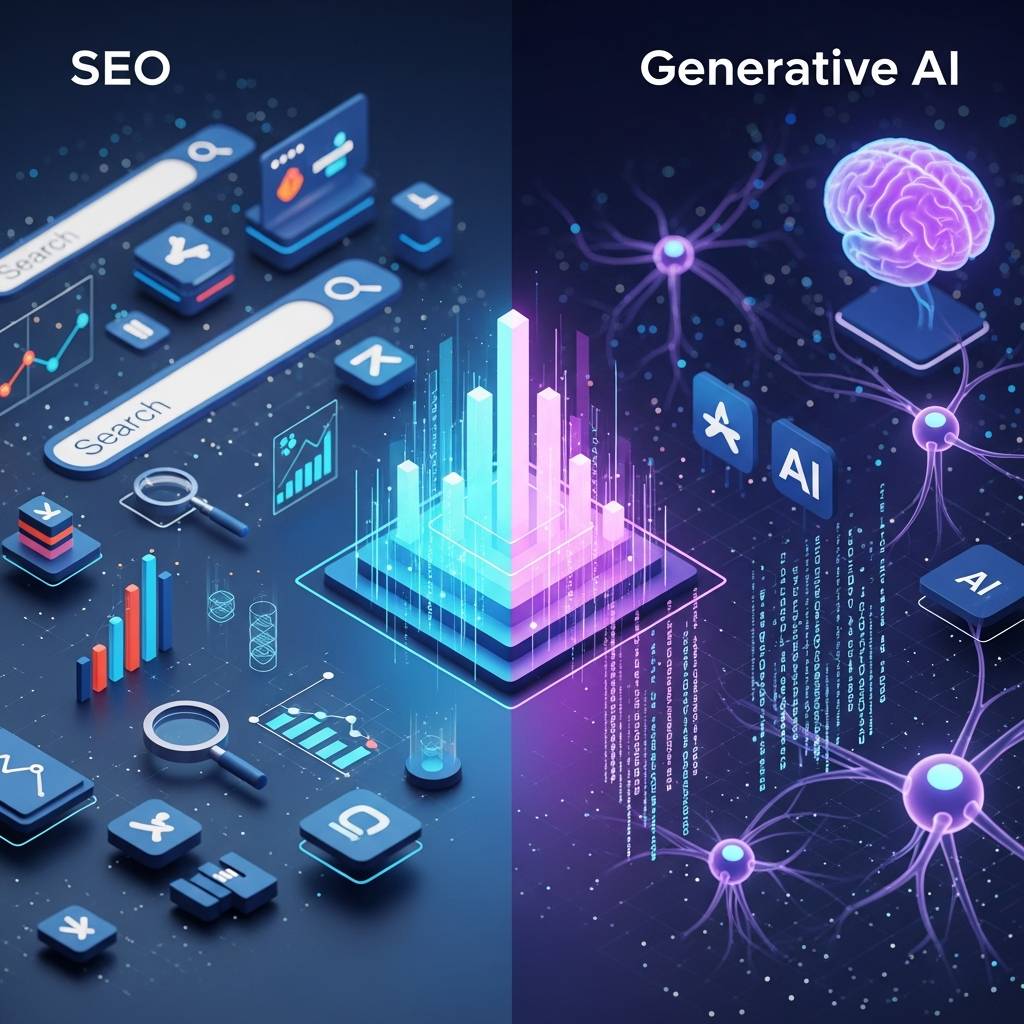
The rules of digital discovery are being rewritten before our eyes. In an era where artificial intelligence is fundamentally changing how users access and digest information, relying solely on traditional Search Engine Optimization is no longer sufficient to maintain a competitive edge. Today, the most successful brands are those that embrace the synergy between established search strategies and the emerging power of Generative AI Optimization (GAO).
To secure your place in the future of the internet, it is essential to evolve beyond simple keyword targeting and understand how large language models interpret and recommend your brand. By harmonizing these two distinct yet complementary disciplines, you can unlock a level of online visibility that traditional methods alone cannot achieve. This evolution is not merely an option; it is a necessity for any business aiming to thrive in the modern ecosystem.
In this comprehensive guide, we will explore the critical steps to transforming your digital presence through SEO and GAO mastery. From implementing a powerful “Dual-Engine Strategy” to unlocking the frameworks necessary for dominating the AI era, we provide the actionable insights you need to future-proof your business and achieve unmatched growth in this new digital landscape.
1. Beyond Keywords: Why Mastering SEO and GAO is Vital for Future-Proofing Your Brand
The digital landscape has shifted dramatically from the days of simple keyword stuffing and link building. While traditional Search Engine Optimization (SEO) remains a cornerstone of digital visibility, it is no longer the sole player in the game. The rapid adoption of Large Language Models (LLMs) has given birth to a critical new discipline: Generative Engine Optimization, or GAO. To future-proof a brand in this evolving ecosystem, businesses must pivot from merely targeting search algorithms to becoming the authoritative source for AI-generated answers.
For decades, the primary goal was to rank number one on Google. However, user behavior is transitioning from typing fragmented keywords into a search bar to asking complex, conversational questions to AI platforms like ChatGPT, Claude, and Perplexity. In this new paradigm, being on the first page of search results is not enough; your brand must be cited as the definitive answer within an AI’s response. This requires a fundamental shift in content strategy, moving away from thin content designed for clicks toward comprehensive, expert-backed resources that LLMs can understand, verify, and reference.
Mastering the synergy between SEO and GAO is essential because modern search engines are becoming hybrid “answer engines.” Platforms like Bing and Google are integrating generative capabilities directly into the search experience. If your digital presence is not optimized for these semantic connections, your brand risks becoming invisible to a growing segment of users who rely on AI for decision-making. Future-proofing your brand means establishing robust digital authority and structured data that signals trust to both traditional crawlers and neural networks alike. By treating SEO and GAO as interconnected disciplines, organizations ensure they remain discoverable regardless of whether a customer is searching via a browser or conversing with an intelligent agent.
2. The Dual-Engine Strategy: How to Supercharge Your Digital Presence with SEO and Generative AI Optimization
In the rapidly evolving landscape of digital marketing, relying solely on traditional Search Engine Optimization (SEO) is no longer sufficient. The emergence of Large Language Models (LLMs) has birthed a parallel necessity: Generative AI Optimization (GAO). To dominate the digital shelf today, brands must adopt a “Dual-Engine Strategy” that simultaneously caters to algorithmic crawlers and generative AI chatbots like ChatGPT, Claude, and Gemini.
While traditional SEO focuses on ranking for specific keywords to drive click-through rates to a website, GAO focuses on being the cited source in a direct answer provided by an AI. This distinction is crucial. In the SEO world, you are competing for a position on a Search Engine Results Page (SERP). In the GAO world, you are competing to be part of the “synthesized answer,” often referred to as position zero on steroids.
The beauty of the Dual-Engine Strategy lies in the synergy between the two disciplines. Generative AI models largely train on and retrieve data from the open web, prioritizing content that is authoritative, well-structured, and highly ranked by traditional search engines like Google and Bing. Therefore, robust SEO practices form the foundation for successful GAO. However, to truly supercharge your presence, you must refine your content architecture to be “machine-readable” in a new way.
To execute this strategy, content creators must shift from keyword stuffing to entity optimization. AI models understand concepts and relationships (entities) rather than just string matching. This means your content needs to clearly define who you are, what you do, and why you are an authority, using distinct, unambiguous language.
Furthermore, structure becomes paramount. Using schema markup and logical headers (H1, H2, H3) helps Google index your page, but it also helps AI parsing tools “understand” the context of your data so they can confidently retell it to a user. For instance, platforms like Perplexity AI rely heavily on citation networks. If your content provides concise, fact-checked summaries alongside deep-dive analysis, you increase the likelihood of being picked up as a reference link within an AI-generated response.
Ultimately, the goal of the Dual-Engine Strategy is omnipresence. By optimizing for traditional search, you capture the user who wants to browse. By optimizing for Generative AI, you capture the user who wants an immediate answer. Mastering both ensures that whether a potential customer asks a search bar or a chatbot, your brand is the answer they receive.
3. Dominate the AI Era: 5 Steps to Transforming Your Online Visibility Through SEO and GAO
The integration of Generative AI into search ecosystems, led by platforms like Google and Bing, has fundamentally shifted how users discover information. Digital visibility is no longer just about ranking for a list of blue links; it is about becoming the cited source in an AI-generated answer. To secure your position in this new landscape, you must evolve from traditional search strategies to a hybrid approach that incorporates Generative Engine Optimization (GAO). Here are five actionable steps to future-proof your digital presence.
1. Implement Comprehensive Structured Data**
AI models and search algorithms rely heavily on structured data to understand the context of your content. By implementing Schema.org markup, you provide explicit clues to search engines about the entities on your page, whether they are products, events, or organizational details. This “machine-readable” layer is critical for GAO, as it helps Large Language Models (LLMs) accurately categorize your data and present it within rich snippets or AI overviews.
2. Focus on Experience, Expertise, Authoritativeness, and Trustworthiness (E-E-A-T)**
Google continues to prioritize E-E-A-T, and AI models follow suit by favoring high-credibility sources to minimize “hallucinations” or false information. To optimize for this, ensure your content is authored by verifiable experts. Include detailed author bios and link to their professional profiles on platforms like LinkedIn. Content that demonstrates first-hand experience and deep expertise is more likely to be selected by AI as the definitive answer to a user’s query.
3. Optimize for Conversational and Long-Tail Queries**
The search behavior is shifting from keyword fragments to natural language questions. Users are now asking, “What is the best running shoe for flat feet under $100?” rather than typing “running shoes.” Adapt your content strategy to answer these specific, complex questions directly. Create FAQ sections and “People Also Ask” clusters that mimic natural conversation, ensuring your text provides concise, direct answers immediately following the heading.
4. Establish Brand Entity and Digital PR**
For an AI to recommend your business, it must recognize your brand as a distinct, authoritative entity. This requires a strong off-page strategy. Secure mentions and backlinks from reputable industry publications and news sites. Consistent citations across the web reinforce the connection between your brand and your specific niche, making it more likely for generative engines to cite your business when synthesizing answers related to your industry.
5. Structure Content for Easy Extraction**
Generative AI models function by ingesting, processing, and summarizing vast amounts of text. To increase the likelihood of your content being featured, structure your articles for easy extraction. Use logical hierarchy with H2 and H3 tags, employ bullet points for lists, and use bold text to highlight key takeaways. When your content is visually and structurally clear, it reduces the computational effort required for AI to parse and present your information to the user.
4. SEO vs. GAO: How to Harmonize Traditional Search and AI Answers for Unmatched Growth
In the rapidly evolving landscape of digital marketing, the conversation has shifted from simply ranking on a page to becoming the foundational source for artificial intelligence. While traditional Search Engine Optimization (SEO) focuses on visibility within the classic list of search results, Generative AI Optimization (GAO)—sometimes referred to as Generative Engine Optimization (GEO)—aims to position your brand as the definitive answer within AI-generated summaries on platforms like Google’s Search Generative Experience (SGE), Bing Chat, and Perplexity AI. The key to unmatched growth lies not in choosing one over the other, but in harmonizing these two powerful disciplines.
To bridge the gap between traditional search and AI answers, marketers must understand that SEO provides the necessary infrastructure for GAO. Technical SEO elements such as site speed, mobile-friendliness, and structured data (Schema markup) are no longer just ranking factors; they are the language that helps Large Language Models (LLMs) understand and verify your content. If an AI cannot crawl and parse your site efficiently, it cannot cite you as a trusted source. Therefore, maintaining a technically sound website remains the first step in any comprehensive strategy.
The harmonization strategy revolves heavily around the concept of “Information Gain” and E-E-A-T (Experience, Expertise, Authoritativeness, and Trustworthiness). While SEO often chases keyword density, GAO rewards depth and unique perspective. AI models are designed to synthesize existing information, so to stand out, your content must offer original data, expert insights, or a distinct point of view that the AI cannot find elsewhere. By publishing high-quality, authoritative content that cites credible sources, you signal to both traditional search algorithms and generative models that your brand is a reference-grade entity.
Furthermore, adapting to a conversational query format is essential. As search behaviors shift toward natural language questions—often voice-activated—content should directly address user intent with clear, concise answers. Structuring articles with explicit headings and direct Q&A formats helps traditional bots index your page for featured snippets while simultaneously making it easier for generative AI to extract and present your information in chat responses. By blending the technical rigor of SEO with the context-rich, authority-driven approach of GAO, you ensure your digital presence is future-proofed, capturing traffic from both the click-throughs of today and the conversational interfaces of tomorrow.
5. Unlocking the Black Box: A Comprehensive Framework for Mastering SEO and GAO in the Modern Digital Landscape
The digital marketing ecosystem has undergone a seismic shift. We have moved beyond the era of simply optimizing for ten blue links on a search results page. Today, the battleground involves conquering both traditional Search Engine Optimization (SEO) and the rapidly emerging field of Generative Engine Optimization (GAO). To unlock the black box of modern algorithms, businesses must adopt a dual-threat framework that appeals to human curiosity and machine logic simultaneously.
At the core of this framework is the concept of “Entity Authority.” Traditional SEO focused heavily on keywords, but Generative AI models—such as those powering ChatGPT, Google Gemini, and Perplexity—operate on semantic understanding. They look for connections between entities (people, places, concepts). To master this, your content must clearly define who you are and what you offer. This involves leveraging knowledge graphs and consistently associating your brand name with specific industry expertise. For example, if you are in the CRM space, your content strategy should position your brand as the definitive source for customer relationship data, much like Salesforce has achieved through decades of authority building.
The second pillar of this framework is Structured Data Mastery. While human readers appreciate engaging narratives, AI models require clean, structured inputs to synthesize answers effectively. Implementing extensive Schema markup is no longer optional; it is the language through which you communicate with the algorithm. By tagging your content with precise schema (e.g., FAQPage, Article, Product), you increase the likelihood of your information being cited in AI-generated snapshots and “zero-click” search results.
Finally, the framework demands a pivot from “content length” to “information density.” In the age of GAO, fluff is penalized. Large Language Models (LLMs) prioritize concise, fact-rich content that can be easily parsed and summarized. This means creating content that directly answers complex questions with unique data, expert quotes, and proprietary research. Platforms like HubSpot and Moz have excelled by becoming repositories of data-driven insights, ensuring they remain primary citations even as AI synthesizes the answers for the user. By integrating these strategies—building entity authority, enforcing technical structure, and prioritizing information density—you ensure your digital presence is not just visible, but essential to the new search infrastructure.
0件のコメント