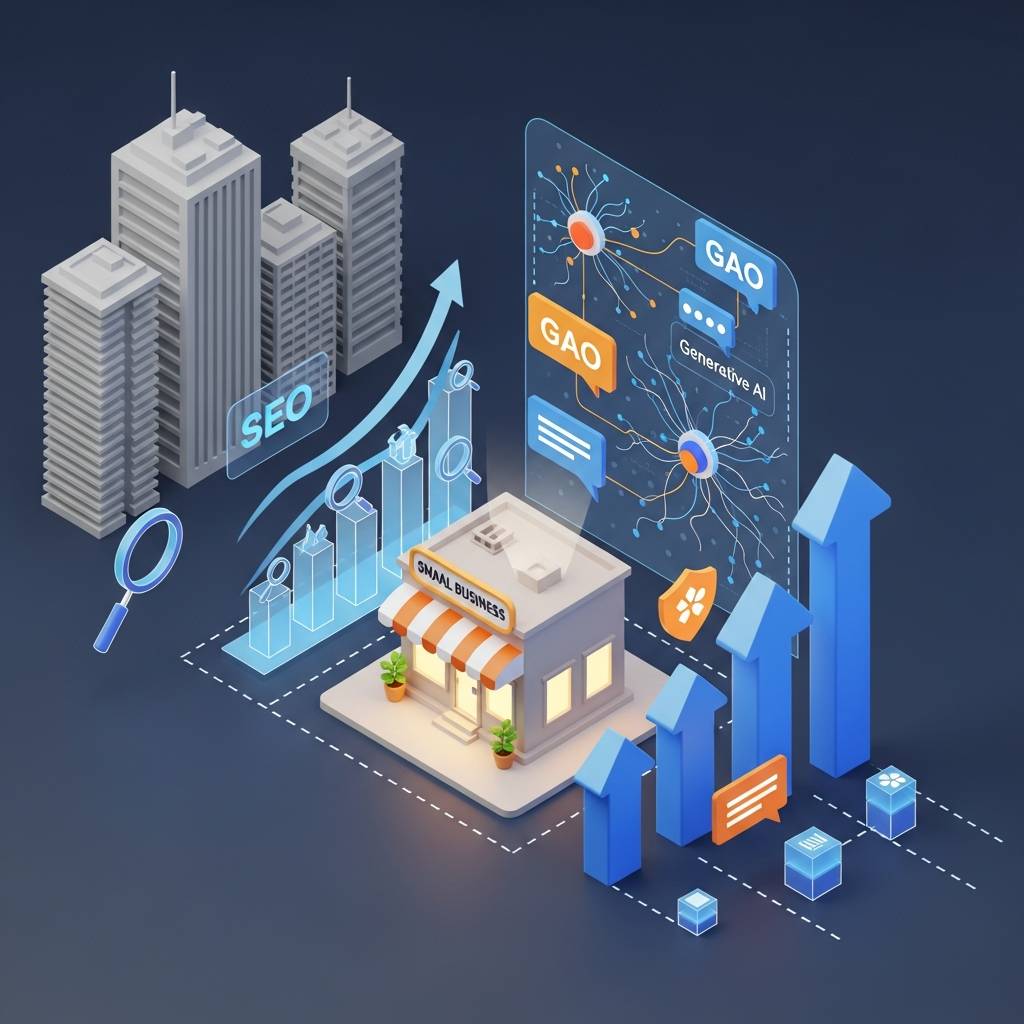
In the rapidly evolving landscape of digital marketing, small businesses often face the daunting challenge of standing out against industry giants with substantial advertising budgets. For years, the battle for online visibility has been fought strictly through traditional Search Engine Optimization (SEO). However, the digital ecosystem is undergoing a paradigm shift. The rise of artificial intelligence has introduced a critical new frontier: Generative AI Optimization (GAO).
As search engines transition from providing simple lists of links to delivering complex, AI-driven conversational answers, the rules of engagement are fundamentally changing. This transformation offers a unique and powerful advantage for agile small businesses. By integrating robust SEO foundations with forward-thinking GAO strategies, smaller enterprises can not only level the playing field but effectively outmaneuver larger competitors who are slower to adapt to these technological advancements.
It is no longer sufficient to simply rank on the first page of search results; the new goal is to become the trusted “answer” provided by AI platforms. This article explores how you can harness the combined power of SEO and GAO to dominate your niche, ensure your brand becomes the cited source in AI responses, and secure sustainable growth. Let us explore the essential tactics that will turn your business into a formidable contender in the future of search.
1. David vs. Goliath: How Small Businesses Can Win Big with SEO and GAO
In the classic tale of David versus Goliath, agility and precision defeated raw power. Today, the digital landscape offers small businesses a similar advantage through the strategic combination of Search Engine Optimization (SEO) and the emerging field of Generative AI Optimization (GAO). While large corporations often dominate broad search terms backed by massive marketing budgets, the evolution of search behavior has leveled the playing field, allowing nimble enterprises to capture high-value traffic by leveraging their unique authenticity and specialized knowledge.
The traditional SEO landscape is shifting. It is no longer solely about accumulating backlinks or ranking for high-volume keywords. The rise of AI-powered search tools, such as Google’s AI Overviews (formerly SGE), ChatGPT, and Perplexity, has introduced GAO as a critical tactic. These generative engines prioritize direct, conversational answers and often favor content that demonstrates deep expertise and clear structure over generic, mass-produced pages. This is where small businesses can outmaneuver larger competitors. By focusing on “long-tail” keywords and answering specific customer questions with genuine authority, a local boutique or specialized consultant can appear as the primary citation in an AI-generated response, effectively bypassing the crowded list of blue links.
Furthermore, small businesses possess a distinct advantage in Local SEO and community engagement, areas where national giants often struggle to maintain relevance. Platforms like Google Business Profile enable local entities to signal immediate availability and relevance to users in their vicinity. By optimizing for local intent—for example, a bakery targeting “gluten-free wedding cakes in Austin” rather than just “cakes”—small businesses can dominate the niche markets that Goliaths overlook. Combining this hyper-local focus with content that adheres to E-E-A-T principles (Experience, Expertise, Authoritativeness, and Trustworthiness) ensures that both traditional search algorithms and generative AI models recognize the business as a trusted resource. In this new digital era, the sling is data-driven, and the stone is high-quality, human-centric content that answers the user’s true intent.
2. The Future of Search: Essential SEO and GAO Strategies for Small Business Growth
The digital landscape is undergoing a seismic shift. For decades, small businesses focused solely on ranking for specific keywords to appear on the first page of Google. While traditional Search Engine Optimization (SEO) remains vital, the rise of artificial intelligence has introduced a new necessity: Generative AI Optimization (GAO). To achieve sustainable growth, small businesses must hybridize these approaches, ensuring they are visible not just in list-based search results, but also as the primary source of information in AI-generated answers provided by platforms like ChatGPT, Microsoft Bing Chat, and Google’s AI Overviews.
The core of this new strategy lies in moving from “keywords” to “conversations.” Traditional SEO was about matching a query like “plumber near me.” GAO takes this further by addressing complex, conversational queries such as, “Who is the most reliable emergency plumber in Seattle for vintage pipes?” To capture this traffic, businesses must restructure their content to answer specific questions directly and authoritatively. This means creating FAQ sections, detailed blog posts, and service pages that mimic natural human dialogue. AI models favor content that provides immediate value and clear logic, rather than pages stuffed with repetitive search terms.
Building authority through E-E-A-T (Experience, Expertise, Authoritativeness, and Trustworthiness) is more critical than ever. Search algorithms and Large Language Models (LLMs) prioritize information from credible sources to prevent hallucinations. Small businesses have a distinct advantage here: niche expertise. By showcasing customer testimonials, detailed case studies, and author biographies of team members with verified credentials, a local business signals to engines like Google that they are a trusted entity. For example, a local coffee roaster should not just list beans for sale but publish in-depth guides on roasting techniques, establishing themselves as the subject matter expert that an AI suggests when a user asks for brewing advice.
Technical implementation also plays a pivotal role in this dual strategy. The use of Schema Markup (structured data) acts as a translator for search engines. By tagging elements of your website—such as operating hours, prices, and reviews—you help AI crawlers understand exactly what you offer. This increases the likelihood of your business being featured in “Rich Snippets” or cited as a source in an AI-generated summary.
Finally, local visibility remains the bedrock of small business growth. Optimizing a Google Business Profile is non-negotiable. Ensure that your NAP (Name, Address, Phone Number) data is consistent across the web. High-quality, recent photos and active responses to reviews feed the local search algorithms, ensuring that when a user asks a voice assistant or a chatbot for recommendations nearby, your business is the top suggestion. By combining the technical foundations of SEO with the conversational, authority-driven focus of GAO, small businesses can future-proof their digital presence and compete effectively against larger corporations.
3. Dominate Your Niche: A Step-by-Step Guide to SEO and Generative AI Optimization
To truly compete with industry giants, small businesses must evolve beyond traditional keyword stuffing. The rise of Large Language Models (LLMs) used by platforms like ChatGPT, Google Gemini, and Perplexity has given birth to Generative AI Optimization (GAO). While SEO focuses on ranking blue links, GAO focuses on being the direct answer cited by AI. By combining these strategies, you can dominate your specific niche. Here is your tactical roadmap.
Step 1: Pivot to Conversational “Answer Engine” Content**
Standard SEO targets short queries like “plumber Atlanta.” However, AI users ask complex questions. To capture this traffic, you must optimize for natural language questions.
* Action: Rewrite your FAQ pages and blog headers to mirror exact questions customers ask on voice search or AI chats. instead of “Services,” use “What emergency plumbing services are available 24/7 in downtown Atlanta?”
* Strategy: Provide concise, direct answers immediately following the heading (approx. 40-60 words). This structure increases the likelihood of being featured in Google’s AI Overviews and cited by chatbots.
Step 2: Establish “Entity” Authority**
Search engines and AI models view businesses as “entities.” If the digital ecosystem doesn’t understand who you are and what you do, you won’t be recommended.
* Action: Ensure your business details (Name, Address, Phone, Website) are consistent across all directories like Yelp, TripAdvisor, and Google Business Profile.
* Strategy: Focus on “Co-occurrence.” Get your brand name mentioned alongside specific niche keywords in industry publications or local news sites. When an AI analyzes text, seeing “Joe’s Coffee” repeatedly near “best organic roast in Seattle” trains the model to associate your brand with that quality.
Step 3: Implement Heavy Schema Markup**
AI bots read code better than they read visual layouts. Structured data (Schema.org) acts as a translator, telling the AI exactly what your content means.
* Action: Use JSON-LD schema to mark up your products, events, reviews, and organization details.
* Strategy: Specifically use the “SameAs” property in your organization schema to link your website to your social media profiles and authoritative citations. This validates your identity and helps AI models confidently verify your business data.
Step 4: Double Down on E-E-A-T**
Google’s E-E-A-T (Experience, Expertise, Authoritativeness, and Trustworthiness) is now critical for GAO as well. AI models are trained to prioritize high-confidence information to avoid “hallucinations.”
* Action: Showcase author bios with real credentials. If you are a financial advisor, list your certifications.
* Strategy: Create unique data. Small businesses often have proprietary data that big corporations lack—such as local customer trends or specific case studies. Publishing original research makes you the primary source, compelling both search engines and AI to cite you as the origin of the information.
By executing these steps, you do not just climb the search rankings; you position your brand as the definitive fact-source that AI assistants rely on to answer user queries. This is how agility beats size in the modern search landscape.
4. Beyond Traditional Search: How to Leverage SEO and GAO to Outsmart Competitors
The digital landscape is shifting rapidly. While ranking on the first page of Google remains crucial, the rise of Generative AI has introduced a new battlefield: Generative AI Optimization (GAO). For small businesses, this evolution presents a unique opportunity to outmaneuver larger, slower-moving competitors by targeting not just search engines, but the “answer engines” that power tools like ChatGPT, Google Gemini, and Microsoft Copilot.
To effectively leverage both SEO and GAO, businesses must move beyond simple keyword stuffing and focus on being the authoritative source that AI models cite. Traditional SEO focuses on keywords and backlinks to rank a link; GAO focuses on content structure, clarity, and context to become the direct answer generated by an AI.
Optimize for Conversational Queries**
Users interact with AI differently than they do with traditional search bars. Instead of typing “best coffee NYC,” a user might ask an AI, “Where can I find a quiet coffee shop in Brooklyn that serves fair-trade beans and has good Wi-Fi?” To capture this traffic, small businesses must adapt their content strategy to answer specific, conversational questions. Create comprehensive FAQ sections and blog posts that directly address complex customer pain points using natural language. This approach satisfies Google’s helpful content update while simultaneously training AI models to associate your brand with specific solutions.
Establish Digital Authority and Citations**
Generative AI models are trained on vast amounts of data and rely heavily on corroboration from trusted sources. To ensure an AI recommends your business, you need a strong footprint across the web. This means maintaining accurate and active profiles on review platforms like Yelp and TripAdvisor, as well as securing mentions in industry-specific publications. When multiple high-authority sites discuss your products or services, AI models are more likely to view your business as a credible entity and reference it in their generated responses.
Structured Data: Speaking the AI’s Language**
While humans read text, machines read code. Implementing structured data (Schema markup) is no longer optional. By marking up your website’s data—such as operating hours, pricing, product availability, and reviews—you provide clear, unambiguous information that search engines and Large Language Models (LLMs) can easily digest. This technical foundation increases the likelihood of your business appearing in Google’s “AI Overviews” and being accurately recommended by chatbots.
The Agility Advantage**
Large corporations often struggle to update their massive web infrastructures quickly. Small businesses possess the agility to implement these SEO and GAO changes immediately. By focusing on niche authority, adopting a conversational tone, and ensuring technical precision with structured data, a local business can effectively bypass the traditional dominance of big brands and connect directly with customers in the age of AI.
5. Skyrocket Your Visibility: 5 Powerful SEO and GAO Tactics Every Small Business Needs
To truly compete with industry giants, small businesses must integrate traditional Search Engine Optimization (SEO) with the emerging field of Generative AI Optimization (GAO). While SEO helps you rank on Google search result pages, GAO ensures your brand is cited and recommended by AI-powered tools like ChatGPT, Gemini, and Perplexity. Here are five actionable tactics to maximize your digital footprint across both landscapes.
1. Target Hyper-Specific Long-Tail Keywords**
Large corporations often dominate broad search terms, but they frequently overlook niche queries. Instead of targeting generic terms like “coffee shop,” focus on hyper-specific long-tail keywords such as “organic fair-trade espresso bar in downtown Seattle.” These phrases have lower competition and higher conversion intent. By creating content that addresses these specific needs, you signal relevance to search engines and provide precise data for AI models looking for specialized recommendations.
2. Structure Content for “Answer Engines” (GAO)**
Generative AI models prioritize content that is easy to parse and understand. To optimize for GAO, structure your blog posts and landing pages using a Q&A format. Clearly state a question in an H2 or H3 header, followed immediately by a concise, direct answer. Using bullet points, numbered lists, and schema markup helps AI bots extract your information accurately, increasing the likelihood that your business will be featured as the primary source in an AI-generated response or a Google Featured Snippet.
3. Maximize Your Google Business Profile for Local Context**
For small businesses, local visibility is paramount. Ensure your Google Business Profile is fully optimized with up-to-date hours, high-quality photos, and accurate service categories. Regularly posting updates and responding to reviews signals activity to Google’s algorithms. Furthermore, AI models often rely on structured databases like Google Maps and Yelp to verify business details when answering location-based queries like “best plumber near me.” An incomplete profile can lead to exclusion from these AI-generated recommendations.
4. Demonstrate E-E-A-T (Experience, Expertise, Authoritativeness, and Trustworthiness)**
Both Google’s search algorithms and advanced language models prioritize credible sources. You can build authority by showcasing the expertise of your team. Include author bios on your blog posts, cite reputable sources, and pursue backlinks from respected local organizations or industry publications. For example, a local bakery could gain authority by being featured on a recognized food tourism site. High E-E-A-T scores tell search engines and AI alike that your content is safe, reliable, and worthy of citation.
5. Publish Unique, First-Hand Data**
AI models are trained on existing data, but they crave new information. One of the best ways to stand out is to publish original research, case studies, or unique customer surveys that cannot be found elsewhere. If you are the original source of a specific statistic or insight, AI tools are more likely to reference your brand when discussing that topic. By contributing fresh knowledge to the web, you position your small business not just as a participant, but as a thought leader in your industry.


0件のコメント