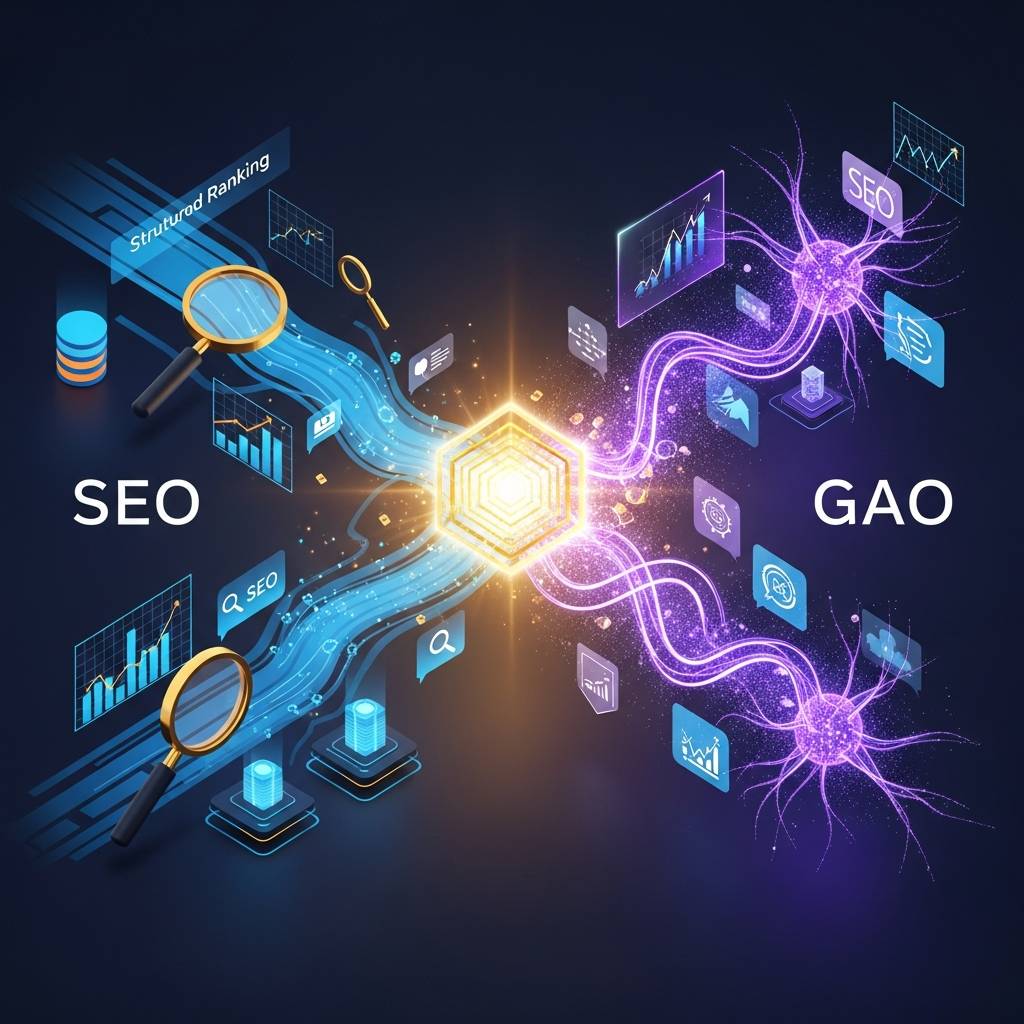
In the rapidly evolving landscape of digital marketing, the way audiences discover information is undergoing a seismic shift. While traditional Search Engine Optimization remains a cornerstone of online visibility, the exponential rise of artificial intelligence has introduced a critical new dimension: Generative AI Optimization. As users increasingly turn to AI-driven platforms for immediate and conversational answers, relying solely on conventional keyword strategies is no longer sufficient to maintain a competitive edge. To secure sustainable growth and maximize your reach, it is essential to bridge the gap between ranking on search engine results pages and appearing in AI-generated responses. This article explores the transformative power of integrating SEO and GAO, offering a comprehensive guide to revolutionizing your content strategy for the future of search.
1. Beyond Keywords: Why Integrating GAO with SEO is the Future of Digital Marketing
The digital landscape is undergoing a seismic shift, moving from the traditional “search and click” model to a “conversational discovery” experience. For decades, Search Engine Optimization (SEO) has been the cornerstone of online visibility, relying heavily on keyword placement and backlink profiles to secure a top spot on the Search Engine Results Page (SERP). However, the mass adoption of Large Language Models (LLMs) and chatbots like ChatGPT, Claude, and Google Gemini has introduced a critical new discipline: Generative AI Optimization (GAO).
Integrating GAO with your existing SEO strategy is no longer optional; it is essential for market relevance. While SEO focuses on ranking links, GAO focuses on becoming the cited source within an AI-generated answer. When a user asks an AI platform a complex question, they are often looking for a synthesized, authoritative recommendation rather than a list of blue links. If your brand information is not optimized to be picked up and synthesized by these models, you effectively do not exist in the rapidly expanding conversational search ecosystem.
This evolution demands a strategy that goes far beyond simple keyword matching. The future of digital marketing lies in optimizing for “intent” and “entities.” Modern algorithms and AI models prioritize context and authority. Therefore, content must be structured to answer specific questions comprehensively, providing proprietary data, unique insights, and clear formatting that LLMs can easily parse and reference. By combining the technical foundation of SEO with the authoritative depth required for GAO, businesses can capture traffic from both traditional search engines and the growing audience relying on AI assistants. This hybrid approach ensures your content remains discoverable and influential, regardless of whether the user is searching on Google or prompting an AI interface.
2. Dominate Search and AI: The Ultimate Guide to Combining SEO and GAO
The digital landscape has fundamentally shifted. It is no longer enough to simply rank on the first page of Google; brands must now ensure they are the cited source within the answers generated by artificial intelligence. While traditional Search Engine Optimization (SEO) focuses on driving traffic through search engine results pages (SERPs), Generative AI Optimization (GAO) targets visibility within Large Language Models (LLMs) such as OpenAI’s ChatGPT, Google Gemini, and Microsoft Copilot. To capture maximum market share, modern content strategies must seamlessly integrate both approaches.
Optimizing for the “Answer Engine”**
The core difference lies in user intent. SEO captures users looking for a list of resources, while GAO captures users looking for a direct synthesis of information. To satisfy both, content must be structured for immediate clarity. Start your articles with direct, concise definitions and answers to specific questions. This “inverted pyramid” style satisfies the algorithms powering Google’s AI Overviews while providing the dense, factual context that LLMs prioritize when generating responses.
The Power of Structured Data and Schema**
Technical foundations are the bridge between SEO and GAO. Implementing robust Schema.org markup helps search crawlers understand the context of your content, leading to rich snippets in search results. Simultaneously, this structured data makes it easier for AI models to parse your website’s information accurately, reducing the risk of “hallucinations” and increasing the probability that your brand is mentioned as a verified source.
Prioritizing E-E-A-T for Trust and Citation**
Experience, Expertise, Authoritativeness, and Trustworthiness (E-E-A-T) constitute the metric by which both search engines and AI models judge value. High-quality content that cites reputable sources, features industry experts, and provides unique data is prioritized by Google’s ranking systems. Furthermore, AI models are trained to favor authoritative domains. By building a reputation as a thought leader—similar to how HubSpot has dominated inbound marketing knowledge—you ensure your content is not just indexed, but actively “learned” and referenced by the next generation of search tools.
3. Unlocking Exponential Growth: How to Synergize SEO and Generative AI Optimization
The digital landscape has shifted from a monologue to a dialogue. To achieve exponential growth, marketers must stop viewing Traditional SEO and Generative AI Optimization (GAO) as separate silos. Instead, the real power lies in their synergy. While SEO captures the user who is searching for a list of options, GAO captures the user who is asking for a synthesized answer. Combining these creates a flywheel effect that dominates both search engine results pages (SERPs) and AI-generated responses.
From Keywords to Entities and Context**
To synergize these strategies, you must pivot your content foundation from simple keyword density to “Entity Optimization.” Search engines like Google and AI models like ChatGPT or Perplexity operate on semantic understanding. They look for connections between entities—your brand, your products, and the concepts they represent.
By ensuring your website clearly defines these relationships using robust Schema markup (structured data), you speak the native language of both Google bots and Large Language Models (LLMs). Structured data eliminates ambiguity, making it easier for an AI to confidently cite your content as a factual source during a chat interaction, while simultaneously boosting your rich snippets in traditional search results.
The Authority Feedback Loop**
The most critical intersection of SEO and GAO is “Authority.” AI models prioritize information from sources deemed highly credible and authoritative to reduce hallucinations. This is where traditional Digital PR and backlink building become vital for GAO.
When you secure mentions on high-authority industry publications or reputable news sites, you signal trust to Google’s algorithms (improving SEO). Simultaneously, because LLMs often weigh these high-authority domains heavily in their training data and retrieval-augmented generation (RAG) processes, your brand becomes associated with the “correct” answer. Use your SEO resources to build high-quality citations; this creates a feedback loop where your content is ranked higher on search engines and cited more frequently by AI chatbots.
Optimizing for the “Answer”**
To capture traffic from AI-integrated search experiences like Bing Chat or Google’s AI Overviews, your content must be structured to answer questions directly. Adopt a “reverse pyramid” writing style: provide the direct answer immediately, then elaborate with data and nuance.
Incorporate natural language questions into your headers (H2s and H3s) that mirror how users speak to voice assistants or type prompts into chatbots. By satisfying the immediate query with precision, you increase the likelihood of becoming the designated “source” link in an AI response. This approach doesn’t just improve visibility; it drives high-intent traffic from users who have already received a preliminary answer and are looking to your brand for the final solution.
4. Adapt or Fade: Transforming Your Content Strategy with the Power of SEO and GAO
The digital landscape is undergoing a fundamental shift that demands immediate attention. For over a decade, marketing teams have focused almost exclusively on optimizing for the search engine results page (SERP). However, with the rapid adoption of Large Language Models (LLMs) like OpenAI’s ChatGPT, Google’s Gemini, and Microsoft Copilot, user behavior is changing from “searching” to “prompting.” To remain visible, brands must pivot from a strictly SEO-centric approach to a hybrid model that integrates Generative AI Optimization (GAO).
Adapting to this new reality means understanding that while SEO focuses on ranking for keywords, GAO focuses on becoming the cited authority within an AI-generated answer. If your content is not optimized for synthesis by AI, your brand risks fading into obscurity, even if your technical SEO is flawless.
The shift from Keywords to Contextual Authority**
To succeed in this dual environment, your content strategy must evolve beyond simple keyword density. Generative AI models prioritize semantic relevance and authority. This means shifting your focus toward “Entity-Based SEO.” Instead of just targeting strings of text, you must establish your brand as a definitive entity associated with specific topics.
For example, successful digital publishers like HubSpot and Search Engine Journal dominate because they structure their content to answer the primary question while simultaneously anticipating follow-up inquiries. This conversational structure mimics how LLMs process information, making it easier for algorithms to extract and summarize their data as the “best answer.”
Actionable Steps for SEO and GAO Integration:**
1. Prioritize E-E-A-T: Google’s emphasis on Experience, Expertise, Authoritativeness, and Trustworthiness is also the bedrock of GAO. AI models are trained to favor credible sources to reduce hallucinations. Ensure your content is authored by verified experts and backed by primary data.
2. Optimize for “Zero-Click” Scenarios: AI Overviews (SGE) often provide the answer directly on the search page. To encourage click-throughs or brand citation, structure your content with clear, concise definitions at the top (for the AI to grab), followed by deep-dive analysis that offers value the AI cannot replicate—such as unique case studies or contrarian viewpoints.
3. Structured Data is Non-Negotiable: Use schema markup aggressively. While humans read your prose, machines read your code. clear schema helps both search crawlers and AI bots understand the relationship between the entities on your page (e.g., product, price, review, author), increasing the likelihood of being featured in rich snippets and AI summaries.
4. Target Long-Tail Conversational Queries: People speak to AI differently than they type into a search bar. Queries are becoming longer and more conversational. Update your FAQ sections to mirror natural language questions.
The choice is clear: cling to outdated tactics and watch your organic traffic erode, or embrace the synergy of SEO and GAO. By optimizing for both the search crawler and the generative engine, you future-proof your digital presence and ensure your brand remains the answer, regardless of where the question is asked.
5. From Search Bars to Chatbots: Maximizing Visibility Through SEO and GAO Integration
The digital landscape is undergoing a seismic shift in how information is accessed. While traditional search engines remain vital, the rapid adoption of AI-powered platforms like ChatGPT, Claude, and Google’s Gemini has introduced a new frontier for content discovery. Users are no longer just typing keywords into a search bar; they are engaging in complex conversations with chatbots to find immediate solutions. This transition necessitates a dual approach: integrating traditional Search Engine Optimization (SEO) with the emerging discipline of Generative AI Optimization (GAO).
To maximize visibility in this hybrid ecosystem, marketers must understand the distinction between ranking for clicks and optimizing for citations. Traditional SEO focuses on driving traffic to a website through keyword relevance and backlinks. In contrast, GAO aims to position your brand as the primary source of truth within an AI’s generated response. This is often referred to as optimizing for the “Answer Engine.” When a user asks an AI tool for recommendations on project management software or advice on financial planning, the goal is for the AI to synthesize your content and cite your brand as the authority.
The bridge between SEO and GAO lies in the strategic use of structured data and high-quality, conversational content. Search engines have long favored clear schema markup, but Large Language Models (LLMs) rely even more heavily on structured inputs to understand the context and relationships between entities. By implementing robust schema markup—such as FAQ, Article, and Product schemas—you provide a clear roadmap for both Google crawlers and AI training datasets. This technical foundation ensures your content is not just indexed, but deeply comprehended and accurately retrievable by generative models.
Furthermore, optimizing for GAO requires shifting from rigid keyword density to natural, intent-based language. AI models are designed to mimic human dialogue and prefer content that directly answers questions in a clear, authoritative tone. Instead of merely targeting short-tail keywords, content strategies should focus on “Zero-Click” optimization by answering specific queries concisely at the beginning of articles. For instance, clearly defining terms or summarizing complex processes helps LLMs easily extract that information for their users.
Ultimately, both SEO and GAO prioritize authority and trust. Google’s E-E-A-T (Experience, Expertise, Authoritativeness, and Trustworthiness) guidelines are universally applicable. LLMs are programmed to prioritize credible sources to minimize the risk of “hallucinations” or false information. Publishing well-researched insights, citing reputable studies, and maintaining a strong digital reputation are essential strategies. By harmonizing these approaches, businesses can ensure they remain visible and relevant, whether a potential customer is clicking a blue link in a search engine or chatting with an intelligent virtual assistant.

0件のコメント