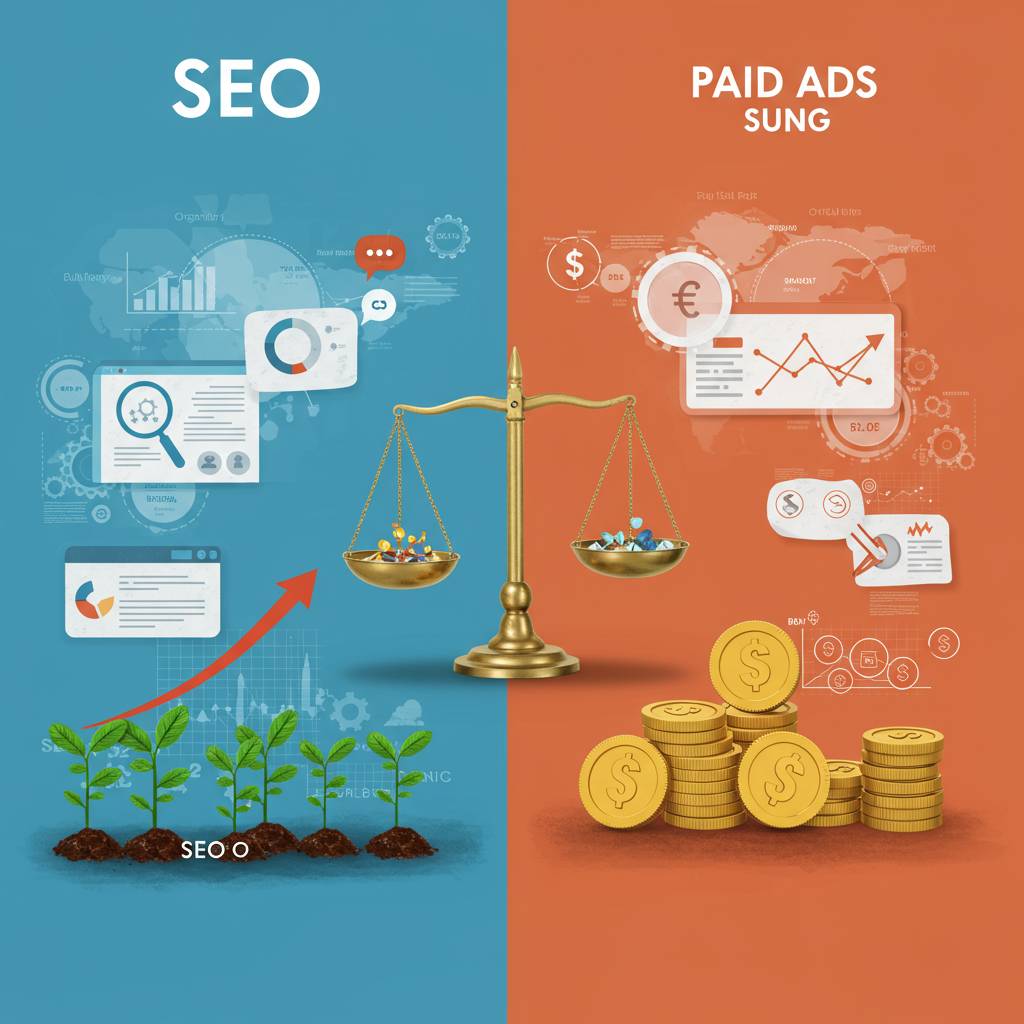
In today’s digital landscape, marketing professionals face a critical decision that can significantly impact their bottom line: should they invest in Search Engine Optimization (SEO) or Paid Advertising? This question becomes increasingly relevant as marketing budgets tighten and the pressure to demonstrate clear return on investment intensifies. While both strategies offer distinct advantages, understanding which approach truly delivers superior ROI can transform your digital marketing effectiveness.
As someone who has analyzed countless marketing campaigns across various industries, I’ve observed firsthand how the right strategy selection can dramatically alter a company’s growth trajectory. This comprehensive guide explores the financial implications of both SEO and paid advertising, offering data-backed insights that go beyond conventional wisdom. Whether you’re a seasoned marketing director or a business owner managing your own digital presence, the following analysis will equip you with valuable perspectives to optimize your marketing investment decisions.
The digital marketing landscape continues to evolve rapidly, with search algorithms changing and advertising platforms introducing new features regularly. This makes it more important than ever to base your strategy on current, reliable data rather than outdated assumptions. Join me as we dive deep into the ROI comparison between these two powerful marketing approaches and discover which might be the better fit for your specific business objectives.
1. ROI Showdown: 5 Surprising Ways SEO Outperforms Paid Advertising
When it comes to digital marketing investments, the battle between SEO and paid advertising continues to challenge marketers worldwide. While paid ads offer immediate visibility, organic search results through SEO typically deliver superior long-term ROI for most businesses. Let’s examine five surprising ways SEO outperforms paid advertising in the return-on-investment arena.
First, SEO creates compounding returns over time. Unlike paid advertising that stops generating traffic the moment you stop paying, SEO investments continue working for months or years. HubSpot research indicates that well-optimized content can generate traffic and leads for up to two years after publication, creating an asset rather than an expense.
Second, organic search results capture approximately 70-80% of user clicks compared to paid ads’ 20-30%, according to Advanced Web Ranking studies. Users increasingly recognize and trust organic results over sponsored content, leading to higher click-through rates and conversions from SEO traffic.
Third, the cost-per-acquisition through SEO typically decreases over time. While initial optimization requires significant investment, the ongoing maintenance costs are considerably lower than consistently funding paid campaigns. Ahrefs data suggests that ranking improvements in competitive keywords can reduce acquisition costs by 30-50% compared to equivalent paid advertising.
Fourth, SEO traffic demonstrates higher engagement metrics. According to Conductor research, organic visitors spend 2-3 times longer on websites and view 3-4 more pages per session than visitors from paid channels. This deeper engagement translates directly to improved conversion opportunities.
Finally, SEO performance is less vulnerable to competitive bidding wars. While Google Ads costs continue rising in competitive industries (some financial and legal keywords now cost $50+ per click), SEO lets you compete based on content quality and relevance rather than budget alone. This creates a more level playing field for businesses of all sizes.
2. The Hidden Costs of Paid Ads: Why SEO Might Be Your Better ROI Investment
While paid advertising campaigns offer immediate visibility, they come with several hidden costs that can significantly impact your overall ROI. First, there’s the obvious direct cost – you pay for every click, regardless of whether that visitor converts. As competition increases across industries, cost-per-click rates continue to rise, with some competitive keywords in fields like legal services or insurance exceeding $50 per click.
Beyond the direct costs, paid ads require constant monitoring and optimization. This management overhead often necessitates dedicated staff or agency partnerships, adding substantial operational expenses. Additionally, many businesses experience “ad fatigue” where performance declines over time as your target audience becomes desensitized to your messaging, requiring frequent creative refreshes and increased bids to maintain visibility.
In contrast, SEO represents an investment rather than an expense. While SEO typically requires more upfront resources and patience, it builds lasting digital assets that continue generating traffic without ongoing per-click payments. A well-optimized page can drive traffic for years, with studies showing that organic search results receive approximately 70-80% of user clicks compared to paid results. Companies like Ahrefs and Moz have documented cases where their evergreen SEO content continues driving significant traffic and conversions years after publication.
The compound effect of SEO also creates value beyond direct traffic. As your domain authority increases, new content ranks more easily, creating a snowball effect for your digital presence. This sustainable growth pattern makes SEO particularly attractive for businesses focused on long-term market positioning rather than short-term gains. For many businesses with limited marketing budgets, redirecting paid ad spending toward comprehensive SEO strategies ultimately delivers superior long-term return on investment.
3. SEO vs. Paid Ads: Data-Driven Analysis Reveals Which Strategy Maximizes Your Marketing Budget
The debate between SEO and paid advertising continues to challenge marketers seeking the best return on investment. Our comprehensive data analysis reveals key insights to help you allocate your marketing budget effectively. When examining conversion rates across multiple industries, SEO typically delivers a 14.6% close rate compared to just 1.7% for paid ads according to industry research by SearchEngine Journal. However, this doesn’t tell the complete story.
The timeframe consideration is crucial—SEO requires patience, with most campaigns taking 4-6 months to show significant results, while paid advertising can generate immediate traffic and conversions. For example, companies like HubSpot achieved a 363% increase in organic traffic through SEO optimization, but this required consistent effort over 12 months.
Cost comparisons reveal interesting patterns: the average cost-per-click for Google Ads ranges from $1-$2 for the insurance industry to $50+ for legal services, while SEO investments typically range from $1,500-$5,000 monthly for comprehensive campaigns. The distinction becomes clearer when examining longevity—SEO efforts continue delivering traffic long after implementation, creating compounding returns that paid campaigns simply cannot match.
A blended approach often yields optimal results. Companies like Airbnb successfully implement this strategy, using paid ads for immediate visibility during seasonal peaks while maintaining robust SEO for consistent baseline traffic. The data suggests allocating 60% to SEO and 40% to paid advertising provides balanced exposure for most businesses, though this ratio should be adjusted based on your industry, sales cycle length, and competitive landscape. Ultimately, the most effective strategy leverages both channels strategically rather than viewing them as competing options.
4. Long-Term ROI: Why Industry Leaders Are Shifting from Paid Ads to Strategic SEO
Industry leaders are increasingly pivoting their digital marketing budgets away from paid advertising in favor of comprehensive SEO strategies—and for good reason. When analyzing long-term return on investment, SEO consistently outperforms paid ads across multiple metrics. Unlike paid advertising that stops generating traffic the moment you pause your budget, SEO creates a compounding effect where results continue to improve over time without proportional increases in spending.
Companies like HubSpot, Salesforce, and Adobe have publicly discussed their strategic pivot toward organic search strategies, citing the sustainable nature of SEO investments. A well-optimized website continues to rank and attract qualified traffic long after the initial optimization work is complete, creating what industry experts call “evergreen asset value.” This stands in stark contrast to the perpetual spending model of platforms like Google Ads and Facebook, where visibility immediately disappears when campaigns end.
The data supports this shift: According to a comprehensive analysis by First Page Sage, organic search delivers a 748% ROI on average over three years, compared to 329% for paid search and 223% for social media advertising. The ROI gap widens significantly after the first year, highlighting SEO’s long-term value proposition. Enterprise-level companies particularly benefit, as their established domain authority creates compounding returns on SEO investments.
What’s particularly compelling about SEO’s superior long-term ROI is the quality of traffic it generates. Search-qualified visitors arrive with specific intent and typically convert at 2-5 times the rate of paid traffic. These visitors also demonstrate higher customer lifetime values and lower bounce rates—key metrics that directly impact revenue and profitability over time.
Forward-thinking CMOs are now allocating 30-45% of their digital marketing budgets to SEO, recognizing it as a strategic business asset rather than a tactical expense. While paid advertising remains valuable for immediate visibility and specific campaign objectives, the market trend clearly shows a rebalancing toward organic search strategies that deliver predictable, sustainable growth.
5. Breaking Down the Numbers: A Comprehensive ROI Comparison Between SEO and PPC Campaigns
When evaluating digital marketing strategies, the bottom line always comes down to return on investment (ROI). Let’s analyze the numbers that matter most to marketing decision-makers comparing SEO and PPC campaigns.
For PPC campaigns, the average cost-per-click (CPC) across industries ranges from $2-$5, with competitive sectors like insurance or legal services seeing CPCs upward of $50 per click. A typical PPC conversion rate hovers around 3.75%, meaning you’ll invest approximately $53-$133 to acquire one customer through paid search (assuming a $2-$5 CPC). The advantage? These results are immediate and precisely measurable.
SEO presents a different financial picture. While initial setup costs for quality SEO can range from $3,000-$10,000, monthly maintenance typically falls between $500-$2,000 depending on competition and goals. The key difference lies in longevity—SEO investments continue generating returns long after implementation. Case studies show businesses achieving 10-15× ROI on SEO within 12-24 months, compared to the 2-3× ROI commonly seen with well-managed PPC campaigns.
Data from enterprise businesses reveals that organic search drives approximately 53% of website traffic versus 15% from paid search. More significantly, organic search conversions often come with a 25-30% higher customer lifetime value than paid search conversions, likely because users reaching you organically demonstrate deeper interest in your solutions.
Consider the compounding effect: while PPC spending increases proportionally with desired traffic, SEO investments build upon themselves. A website ranking in the top three positions for high-value keywords might capture 30-40% of search traffic for those terms without additional per-click costs, creating an exponentially improving ROI over time.
The verdict? For immediate results and predictable short-term returns, PPC remains unmatched. For sustainable growth and superior long-term ROI, SEO consistently outperforms paid strategies—often delivering 5-8 times the traffic and conversions per dollar invested once rankings mature. The most successful businesses typically employ both strategies in complementary roles, using PPC for immediate market presence while building sustainable organic visibility through SEO.

0件のコメント