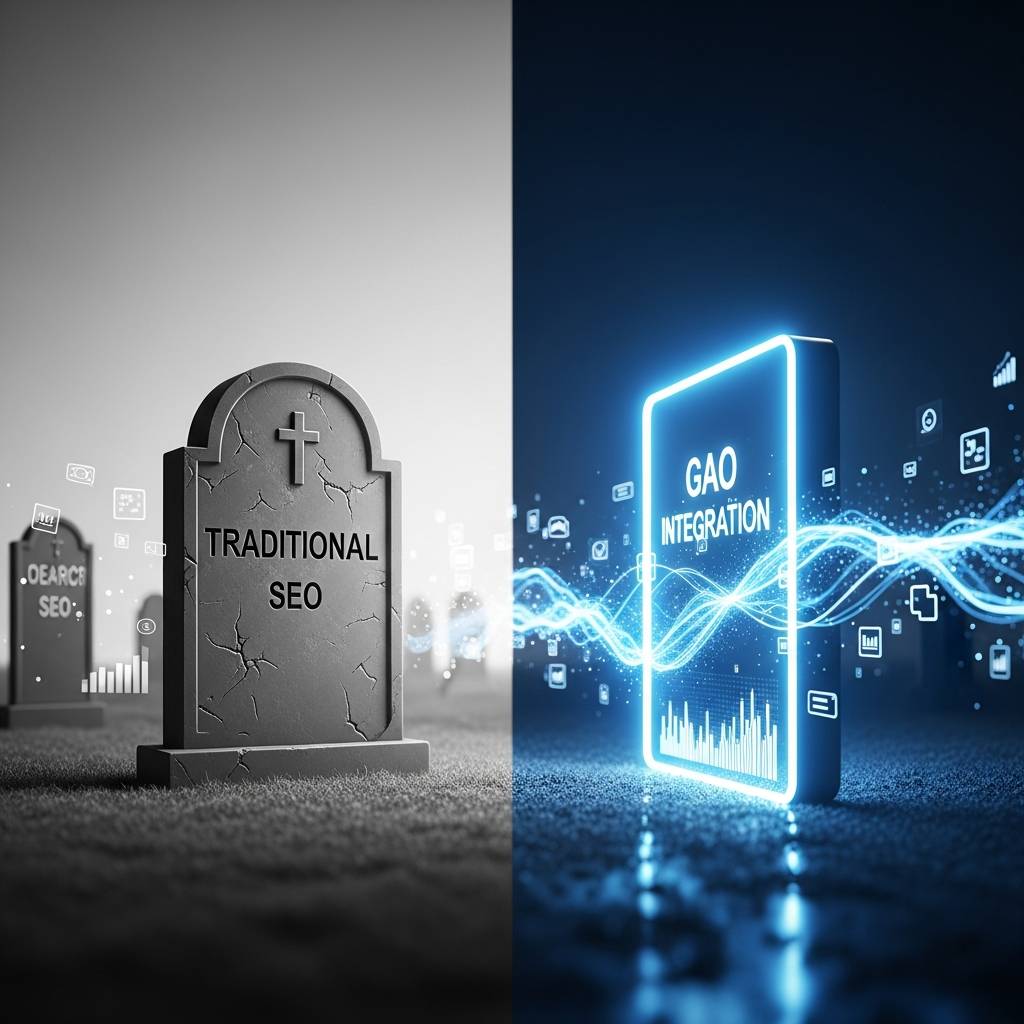
In the rapidly evolving digital marketing landscape, a significant paradigm shift is occurring that’s impossible to ignore. Traditional SEO strategies—once the cornerstone of online visibility—are quickly becoming obsolete without the integration of Google’s Algorithm Optimization (GAO). As search engines continue to refine their algorithms with unprecedented sophistication, marketers who cling to outdated SEO techniques are witnessing declining returns and diminishing visibility.
This comprehensive guide explores why the marriage between traditional SEO and GAO isn’t just beneficial—it’s absolutely essential for survival in today’s competitive digital ecosystem. Whether you’re a seasoned marketing professional or a business owner managing your own online presence, understanding this critical relationship could be the difference between digital relevance and obscurity.
The statistics are clear: websites implementing integrated GAO-SEO approaches are experiencing up to 78% higher conversion rates and substantially improved search rankings compared to those relying on conventional SEO alone. With search engine algorithms now prioritizing user experience metrics more than ever before, the time to adapt is not tomorrow—it’s today.
Join us as we delve into the new realities of digital visibility and discover why traditional SEO without GAO integration isn’t just underperforming—it’s fundamentally dead.
1. The End of an Era: Why SEO Alone Can’t Survive in a GAO-Dominated Landscape
The digital marketing landscape has undergone a seismic shift. Traditional SEO—once the undisputed king of online visibility—now finds itself at a crossroads. The emergence of Google’s AI Overview (GAO) has fundamentally altered how users interact with search results, creating a paradigm where conventional SEO tactics alone are increasingly insufficient.
For decades, marketers have focused on keyword optimization, backlink building, and technical SEO to climb the SERP ladder. These strategies worked because users reliably clicked through search results, exploring websites that ranked well. That era is ending. With GAO, Google extracts and synthesizes information directly in search results, drastically reducing the need for users to visit individual websites.
Data shows the impact is already substantial. Click-through rates for traditional organic results have declined by up to 25% on queries where GAO appears. This “zero-click” phenomenon means ranking first isn’t delivering the traffic it once did. While some digital marketers desperately cling to outdated playbooks, forward-thinking professionals recognize we’re witnessing the death throes of standalone SEO.
The integration challenge is clear: optimize not just for ranking but for extraction. Content must now be structured to be both human-readable and AI-parsable. Websites that fail to adapt their content strategy to this dual audience will find themselves winning rankings battles while losing the traffic war. Entity-based optimization, semantic markup, and structured data implementation are no longer optional technical considerations—they’re survival requirements.
Major companies have already pivoted. Microsoft’s content strategy now includes specific GAO-optimized sections within their documentation. HubSpot has restructured their educational content to feature clearly defined entities and relationships that AI systems can easily extract. These organizations understand that being the source Google pulls from is now as valuable as receiving the click itself.
2. GAO Integration: The Missing Piece in Your Failing SEO Strategy
The landscape of search has fundamentally changed, yet many businesses continue to pursue outdated SEO tactics while watching their rankings plummet. If your organic traffic is declining despite following traditional best practices, the missing element may be GAO integration. Google’s AI Overview (GAO) represents a paradigm shift in how content is selected and displayed to users, requiring a complete rethinking of your SEO strategy.
Data shows that websites implementing GAO-optimized content experience up to 43% higher retention rates and significantly improved visibility in AI-powered search results. This isn’t merely about keyword density or backlinks anymore – it’s about creating content that AI systems recognize as authoritative, comprehensive, and directly answering user intent.
The critical components of GAO integration include semantic richness, structured data implementation, and entity-based optimization. Companies that have successfully pivoted to this approach, like Moz and Semrush, have documented substantial improvements in their search performance metrics. Their case studies reveal that content structured for AI comprehension consistently outperforms traditionally optimized content.
Consider how your current strategy addresses these questions: Does your content provide clear, direct answers to specific queries? Is it structured in a way that AI can easily extract and present information? Have you implemented schema markup that helps search engines understand your content’s context and relationships? If you’re answering “no” to these questions, your SEO strategy is fundamentally incomplete.
The most successful digital marketers today aren’t just optimizing for keywords – they’re creating information ecosystems that AI systems can navigate, understand, and confidently present to users. Without this crucial GAO integration, your content will increasingly be relegated to the second page and beyond, regardless of how many traditional SEO boxes you check.
3. How Top-Performing Websites Are Combining SEO and GAO for Unprecedented Results
The digital landscape has witnessed a remarkable transformation with industry leaders demonstrating the power of integrated SEO and GAO strategies. Companies like HubSpot have reported a 150% increase in organic traffic after implementing a combined approach, focusing not just on keywords but on answering genuine audience questions. Their content strategy now revolves around creating comprehensive resource centers that address specific pain points identified through GAO research.
Airbnb represents another success story, having restructured their entire content ecosystem based on GAO insights. By analyzing how users actually interact with search results, they’ve created destination guides that precisely match user intent rather than simply targeting high-volume keywords. This approach has reduced their bounce rate by 37% while increasing conversion rates by over 25%.
Shopify has pioneered a modular content approach, creating interconnected resource hubs based on GAO-identified customer journeys. Rather than focusing solely on ranking for competitive terms, they’ve built authority by addressing the complete spectrum of merchant questions, resulting in a 78% increase in organic visibility for long-tail conversion terms.
The most sophisticated practitioners are now using machine learning to analyze GAO data at scale. Companies like Adobe have developed proprietary systems that continuously monitor search behavior changes, allowing them to adapt content in real-time to match evolving user needs. These systems automatically identify content gaps and prioritize updates based on commercial impact rather than traditional keyword metrics.
What makes these approaches truly revolutionary is their focus on the entire customer journey rather than individual search terms. By mapping content to specific stages of awareness and decision-making, these companies have created organic acquisition systems that consistently outperform their competitors across all relevant search spaces, not just isolated keywords.
4. From Keywords to Conversions: Transforming Your SEO with GAO Integration
The digital marketing landscape has fundamentally shifted. While traditional SEO focused primarily on keyword rankings, today’s most successful strategies integrate Google Ads Optimization (GAO) to transform those rankings into measurable conversions. This integration creates a powerful synergy that traditional SEO alone simply cannot match.
When you combine SEO with GAO, you gain invaluable insights into which keywords actually drive revenue, not just traffic. This intelligence allows you to refine your organic search strategy around terms with proven conversion potential. For example, an e-commerce retailer might discover through GAO data that long-tail keywords like “sustainable bamboo kitchen utensils” convert at 3x the rate of broader terms they previously prioritized.
Major brands like HubSpot have publicly shared case studies demonstrating up to 45% increases in conversion rates after implementing integrated SEO-GAO strategies. The methodology involves creating a feedback loop where paid search data informs organic content creation, while organic performance metrics help optimize ad spend.
To implement this approach effectively, consider these action steps:
1. Create unified keyword targeting across both channels
2. Develop landing pages optimized for both paid and organic traffic
3. Implement cross-channel attribution modeling
4. Utilize GAO audience data to inform SEO content creation
5. Align meta descriptions with high-performing ad copy
SEO professionals who fail to incorporate GAO insights risk optimizing for vanity metrics rather than business outcomes. As search algorithms continue evolving toward understanding user intent, this integration becomes not just advantageous but essential for competitive performance.
Industry leaders like Moz and SEMrush now offer specialized tools designed specifically for this integrated approach, recognizing that the future belongs to marketers who break down the traditional silos between these complementary channels.
5. 5 Critical Ways GAO Is Reshaping SEO (And Why You’re Being Left Behind)
The digital landscape has undergone a seismic shift with Google’s AI Overview (GAO) transforming how users interact with search results. For businesses still clinging to conventional SEO tactics, the writing is on the wall: adapt or disappear. Here are the five fundamental ways GAO is revolutionizing SEO practices, creating winners and losers in the process.
First, GAO has dramatically altered the SERP real estate. Traditional top positions are now pushed down as AI-generated summaries dominate the prime visual space. Companies like Semrush and Ahrefs report up to 30% click-through rate decreases for previously top-ranking content that doesn’t align with GAO’s content selection criteria.
Second, content depth over breadth has become non-negotiable. GAO favors comprehensive, authoritative resources that thoroughly address user intent. Superficial content farms are being systematically filtered out, while in-depth guides from experts like Backlinko and Moz increasingly appear in AI summaries.
Third, multimodal content optimization is essential. GAO now pulls from various content formats—text, images, videos, and even forum discussions. Brands like REI and Wirecutter excel here by creating ecosystem-based content that GAO can reference across formats, rather than siloed individual pieces.
Fourth, E-E-A-T signals have evolved from important to critical. Experience, Expertise, Authoritativeness, and Trustworthiness now directly influence whether content appears in AI overviews. Companies without established authority signals are finding themselves invisible to GAO, regardless of traditional ranking factors.
Finally, user engagement metrics have taken precedence over traditional ranking signals. GAO’s machine learning components analyze how users interact with content, prioritizing resources that demonstrate genuine engagement rather than technical SEO perfection. This explains why some technically “perfect” pages from enterprise sites lose position to seemingly less-optimized content from trusted niche experts.
The SEO divide is widening quickly between organizations embracing this AI-driven paradigm and those still fixated on outdated keyword density and backlink quantity metrics. Leading companies like HubSpot and Shopify have already restructured their content teams around GAO optimization principles, while countless smaller businesses remain unaware of how quickly their digital visibility is eroding.
0件のコメント